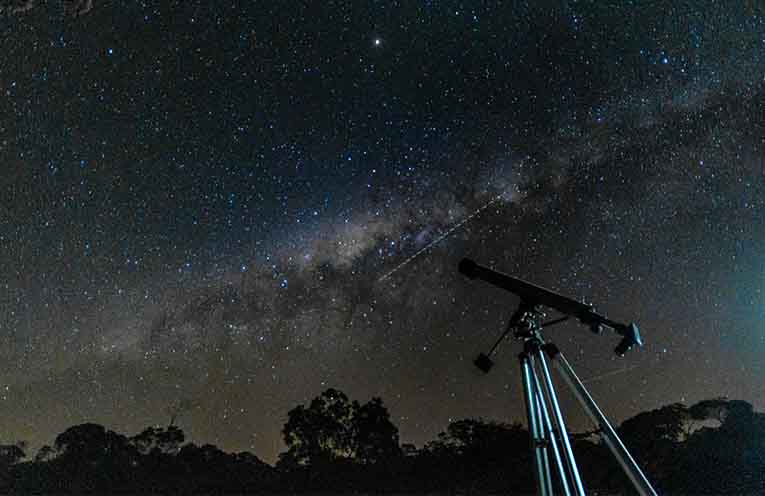
WINTER astronomy in Australia comes with a bonus much of the world would envy: crisp, clear skies that seem polished overnight.
Right now, in the Hunter and Mid North Coast, the heavens are putting on a dazzling performance.
Tonight, step outside with me into your own backyard observatory. No ticket needed. Just curiosity.
And here’s the spooky part.
The starlight hitting your eyes tonight began its journey hundreds, sometimes thousands, of years ago.
Some of those stars might not even exist anymore.
Yet their ancient light is only arriving now.
Every time you look up, you’re peering into history itself. Forget Hollywood time machines, your telescope is one.
New to astronomy? Don’t panic about learning all those stars and constellations.
Nobody becomes an overnight Galileo sitting indoors glued to a keyboard.
Astronomy is wonderfully hands-on. The best classroom on Earth is the night sky itself.
Ironically, the very thing people blame for keeping us indoors – our phones and tablets – can become the perfect guide to the cosmos.
Modern astronomy apps are astonishingly clever.
Point your phone skyward and suddenly the universe introduces itself.
One of the best is the free mobile app SkyView.
It identifies almost everything above your head in seconds.
Curious about the Moon? Try The Moon for craters, phases, and lunar details.
Then there are the free ISS Flyover apps, which alert you when the International Space Station glides overhead like a silent UFO carrying astronauts travelling at 28,000 kilometres an hour.
But wait until you try Star Chart.
This little beauty turns your tablet or laptop into a virtual planetarium.
Using GPS technology, it maps every visible star and planet above you in real time.
It feels less like software and more like science fiction.
If you really want to tumble down the rabbit hole, install Stellarium. It’s free, astonishingly realistic, and dangerously addictive. Hours vanish before you know it.
Another favourite is Celestia, which lets you roam through the universe like the captain of your own starship.
Humanity’s fascination with the stars stretches back tens of thousands of years.
Indigenous cultures worldwide used the sky as a calendar, compass, storybook, and spiritual map.
Long before GPS, the stars guided entire civilizations across oceans and deserts.
And here’s a surprise: your smartphone can now double as an astro-camera. Seriously.
Today’s phones are remarkably good at capturing the night sky. You don’t need expensive equipment or a degree in astrophysics.
A cheap tripod helps, although I’ll confess I’ve used Blu-Tac and sticky tape in desperate moments.
Want to photograph the Moon through your telescope? Easy.
Modern phone adapters like the Celestron NexYZ 3-Axis Universal Smartphone Adapter make it simple to capture lunar craters, eclipses, Saturn’s rings, and even bright planets.
For night photography, the mobile app NightCap Camera is brilliant.
Hold your phone steady, tap the shutter, and suddenly your backyard starts looking like a NASA press release.
The universe is waiting outside tonight.
Jupiter, star clusters, shooting stars, maybe even a passing satellite or two. All from your own backyard.
Who knows? One glance upward might spark the same wonder that inspired generations before us to ask the biggest question of all: what’s out there?
By David RENEKE