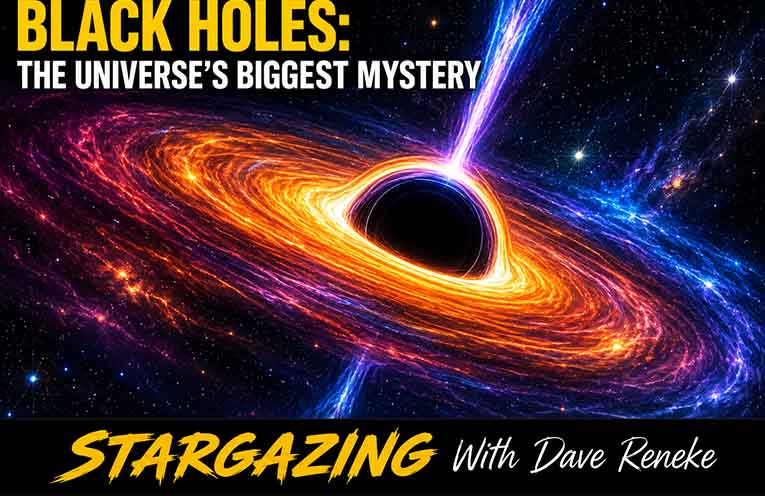
IMAGINE a place where nothing can escape – not even light. It sounds like science fiction, but these strange objects really do exist. They are called black holes, and they are among the most mysterious things in the universe.
We can’t see a black hole because it gives off no light. Instead, we find them by watching how they affect the stars and clouds of gas around them. Their gravity is so powerful that anything that gets too close is pulled in.
The idea of black holes isn’t new. Back in 1783, an English scientist named John Michell wondered if a very heavy star could have gravity so strong that even light couldn’t escape. It was an incredible idea for a time when no one really understood how stars worked.
Then, in the 1960s, astronomers found convincing evidence they were real.
In 2019, the world saw the first picture of one – a bright ring of glowing gas surrounding a dark centre.
A black hole begins life as a giant star, much bigger than our Sun, but one day that fuel runs out. Without anything to hold it up, the star collapses under its own enormity into a ball only a few kilometres across.
It becomes so tightly packed that its gravity grows unbelievably strong. Once anything crosses that line, there is no way back. Even light cannot escape, which is why black holes appear completely black.
Many people think black holes are giant vacuum cleaners, sucking up everything around them. That’s not true. They only pull strongly on objects that come close.
If someone fell towards a black hole, something very strange would happen. The pull of gravity on their feet would be much stronger than the pull on their head. Little by little they would be stretched longer and thinner until they looked like a strand of spaghetti.
Black holes also slow down time. Near a black hole, a clock would tick more slowly than one on Earth.
If astronauts could somehow travel close to a black hole and safely return, they might find that many more years had passed back home than they had experienced themselves.
It sounds impossible, but experiments have shown that gravity really does affect time.
Some people wonder if black holes are giant tunnels leading somewhere else.
Scientists have imagined mysterious shortcuts through space called wormholes. These would be like tunnels through a mountain instead of driving all the way around it. They might connect distant parts of the universe, or perhaps even different universes altogether.
It is an exciting idea, but no one has ever found a wormhole, and we don’t know if they really exist.
Scientists have also imagined something called a white hole. It would be the exact opposite of a black hole.
A black hole only pulls things in and a white hole would only push things out. Nothing could ever enter it.
For now, though, they remain an interesting theory.
Could we ever travel through a black hole? With everything we know today, the answer is almost certainly no.The crushing gravity would destroy any spacecraft long before it reached the centre.
But science is always discovering new things, and the universe has surprised us many times before.
Black holes may be the darkest places in the universe, yet they are helping us unlock some of its brightest secrets. Every discovery brings us one step closer to understanding gravity, time, space and the incredible universe we call home.
By Dave RENEKE