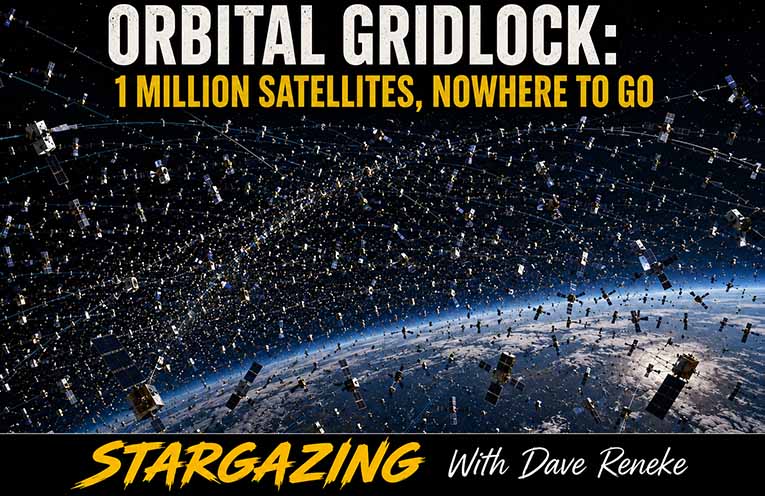
IMAGINE looking up at the night sky and seeing not stars, but thousands of moving lights crossing overhead.
Now imagine that number growing into the millions.
It sounds like science fiction, yet that’s the scale of a proposal now being fiercely debated by scientists around the world.
SpaceX has filed plans that could eventually see up to one million orbiting satellites supporting space-based artificial intelligence data centres.
The idea is bold: move the enormous power demands of AI computing into space, where the Sun shines continuously and solar energy is abundant.
Supporters argue it could reduce pressure on Earth’s electrical grids and create an entirely new era of computing.
But critics warn the environmental cost could be staggering.
Every satellite has a limited lifespan. When it reaches the end of its mission, it burns up during re-entry, releasing aluminium oxides and other metallic particles high in the atmosphere.
Scientists fear that if hundreds of thousands, or even a million satellites are continually replaced, the cumulative effect could transform the upper atmosphere into what one researcher described as a “fire pit.”
The concern isn’t simply the fiery spectacle of re-entry; it’s the long-term build-up of pollutants that may damage the ozone layer and alter Earth’s climate in ways we barely understand.
Astronomers have another reason to be worried.
Today’s Starlink network already numbers more than 10,000 operational satellites, and bright satellite trails routinely interfere with astronomical observations.
A constellation hundreds of times larger could permanently change the appearance of the night sky, making it increasingly difficult for professional observatories to study distant galaxies, detect hazardous asteroids, or discover new worlds.
Some researchers believe the impact on astronomy would be devastating.
The proposal has also reignited criticism of how commercial space projects are regulated.
Environmental organisations argue that licensing for enormous satellite constellations is moving ahead without the kind of comprehensive environmental assessments expected for major developments on Earth.
They say humanity is turning near-Earth space into an industrial zone before fully understanding the consequences.
That criticism deserves serious consideration.
Space exploration has always inspired wonder. Satellites connect remote communities, assist emergency services and expand scientific knowledge.
SpaceX, in particular, has revolutionised launch technology and dramatically lowered the cost of reaching orbit.
Yet progress without adequate oversight carries risks. The night sky is one of humanity’s oldest shared treasures. Once altered on a global scale, it cannot easily be restored.
Whether a million orbiting AI satellites are technically or economically achievable remains uncertain.
Many engineers question the enormous challenges of cooling data centres in space, maintaining them, and launching them in such vast numbers. Even so, scientists argue that the debate must happen before the launches, not after.
The race to dominate artificial intelligence could become the next great space race.
The question is whether humanity can embrace that future without sacrificing the pristine skies and fragile atmosphere that have protected and inspired us for millennia.
Why not join me for an unforgettable Norfolk Island ‘STARGAZING’ adventure in April next year.
Enjoy exceptionally dark skies, spectacular stars, planets and deep-sky wonders, with expert guidance, fascinating stories and relaxed evenings under the stars.
Discover the universe from one of Australia’s most beautiful and naturally dark-sky destinations and have a holiday that’s ‘Outta This World.’
Go to my website for details www.davidreneke.com or phone for a brochure 0400 636 363.