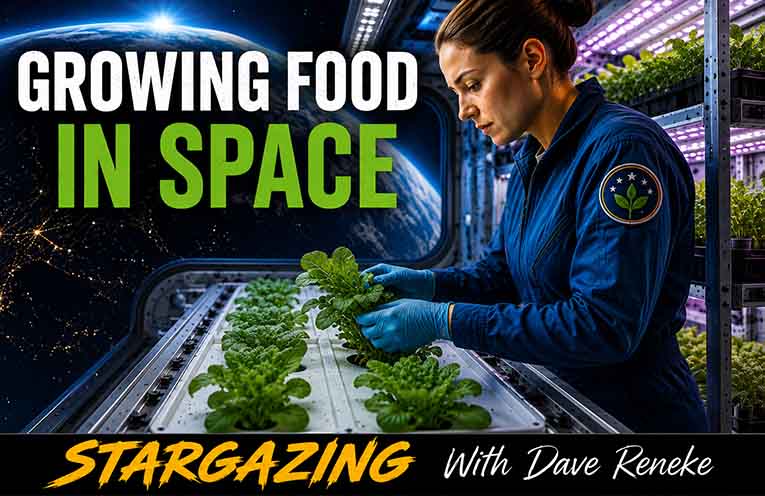
WHEN astronauts eventually set foot on the Moon for months at a time, or establish the first human settlement on Mars, they’ll face a challenge that’s just as important as rockets and spacesuits: growing fresh food.
Taking enough supplies from Earth simply isn’t practical for long missions, so future explorers will need thriving gardens millions of kilometres from home.
That raises an intriguing question. What happens to seeds and plants after spending long periods in space? Scientists have been searching for the answer for decades.
Experiments aboard the International Space Station (ISS) have shown that many seeds survive spaceflight remarkably well. Once returned to Earth, most germinate normally.
Living in orbit is far from ideal for plants. Microgravity, increased radiation and an unusual environment all influence the way they grow.
On Earth, gravity tells roots to grow down and stems to grow up. In space that natural guide disappears. Roots can grow in unexpected directions, while water no longer drains through soil as it does at home. Instead, it clings to roots in tiny floating droplets, making it harder for plants to absorb oxygen.
Researchers have had to invent clever watering systems that deliver just the right amount of moisture without drowning the roots.
Radiation presents another challenge. Outside Earth’s protective atmosphere, energetic particles constantly bombard spacecraft.
Over long periods they can damage plant cells and even alter DNA.
Most changes are harmless, but scientists carefully monitor seeds for mutations that could affect future harvests. Surprisingly, some plants become more resilient after exposure to stressful conditions, opening the door to developing tougher crop varieties.
Scientists have also discovered that a plant’s nutritional value can change in space. Studies of lettuce, radishes, dwarf wheat and leafy greens have shown small variations in vitamin C, antioxidants and other beneficial compounds. Sometimes the levels decrease slightly, while in other cases they actually increase as plants respond to environmental stress.
Flavour and texture can also differ from Earth-grown produce. The good news is that carefully controlled lighting, nutrients and temperature can produce crops that are healthy, safe and enjoyable to eat.
Growing food in space isn’t only about nutrition. Fresh vegetables also provide psychological benefits. Caring for living plants gives astronauts a welcome connection to Earth, while the colour, smell and taste of fresh produce can lift morale during long missions in the isolation of space.
The technology being developed is impressive. Instead of traditional soil, many experiments use hydroponics, where roots grow in nutrient-rich water, or aeroponics, where they are misted with nutrient solutions.
LED lights provide the perfect mix of colours for photosynthesis while using very little electricity. Computers constantly monitor moisture, temperature, nutrients and carbon dioxide to create the ideal growing conditions.
These techniques will eventually be adapted for the Moon. Lunar greenhouses will probably sit inside pressurised habitats or beneath protective domes shielded from radiation and extreme temperatures.
Processed lunar soil, known as regolith, may one day help anchor roots, while recycled water and astronaut waste will become valuable resources in a nearly closed farming system.
Mars presents even greater challenges, but also exciting possibilities. Its day is only about 40 minutes longer than Earth’s, making lighting schedules easier for crops. Scientists hope to use water ice buried beneath the Martian surface and carbon dioxide from the thin atmosphere to help sustain future greenhouses.
Every successful experiment brings humanity one step closer to becoming an interplanetary species. Tiny seeds that begin their journey inside a spacecraft today could someday feed entire communities on distant worlds.
By Dave RENEKE