WHEN asked at what point she decided to become a novelist, Susannah Glenn replied: “That’s easy.
“I was sacked, and they paid me a lot of money to go away”.
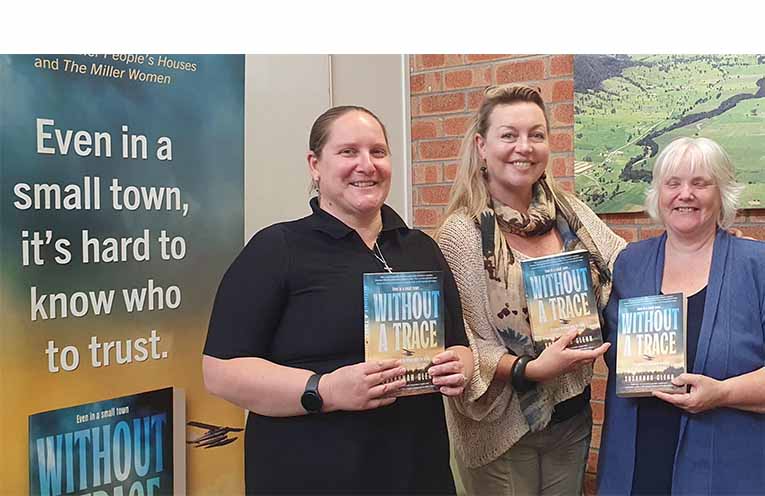
Glenn was Gloucester Library’s featured author for October.
Her recent second novel, Without a Trace, follows her first book, Between Husbands and Wives, published in 2024.
Both are domestic noir, a genre she was introduced to by an English teacher whose set reading list included Daphne Du Maurier’s novel, Rebecca. She was fascinated with thrilling stories, told from a female perspective that created tension when the main protagonist didn’t know who or what to trust.
Write what you love is Glenn’s advice to aspiring writers.
She’s drawn to beautiful locations with a darker presence.
From an early age, wanderlust was nurtured in her family, which travelled to remote regional areas in Australia in a caravan as well as planes restored by her father.
Such experiences exposed her to new faces, places and stories and fired her imagination.
Her love of reading opened up other worlds and inspired her to become a writer.
She credits her grandmother Marjory, a prolific writer and reader of poetry, with fostering her love of words.
Her family lived in the Kempsey area for a number of years, where she attended school.
Glenn completed a communications degree at the University of Newcastle and moved into a successful career in journalism with News Limited, Fairfax, Macquarie Publications and Australian Provincial Newspapers.
Career changes and family life took her to Fiji, Port Douglas, Brisbane and Coffs Harbour.
Eventually she moved to the Mid Coast where she enjoyed working in local government promoting tourism in creative ways.
When management restructuring made her position redundant, she was crestfallen.
“My husband Stuart has no tolerance for self-pity,” Glenn explained.
He asked: “What do you really want to do?”
She replied: “I want to write a book.”
He said: “Then write a book.”
So, she did. Although it took three years and 10 drafts to complete.
“While I was writing a novel, I was undertaking courses and learning to write one.”
Location is important but her books are character-driven.
“I liken writing to what an artist does with their canvas,” Glann said.
“You start with a broad outline, and you fill it in in a way that feels natural.
“Sometimes it doesn’t work and you have to start over.”
Susannah follows Fiona Mackintosh’s advice, ‘Have a contract with yourself.’
She works three to five hours each weekday and aims for 1500 to 2000 words.
‘The manuscript has to be as good as it can be before submitting it to a publisher,’ she emphasises.
She has three pieces of advice to would-be writers:
– Don’t be afraid of imperfection. The first draft is just one of many, and each revision will build layers that flesh out character, location and plot.
– Be professional. Treat it as a job. Turn up and get it done.
– Read as much as you can. “You learn so much when you read as a writer.”
Her disciplined approach paid off: Glenn’s first novel was accepted by Pantera Publishing and she signed a two-book deal.
Glenn’s journey towards becoming a published storyteller is proof that dreams can come true if you leave nothing to chance.
By Marilyn SANDERSON