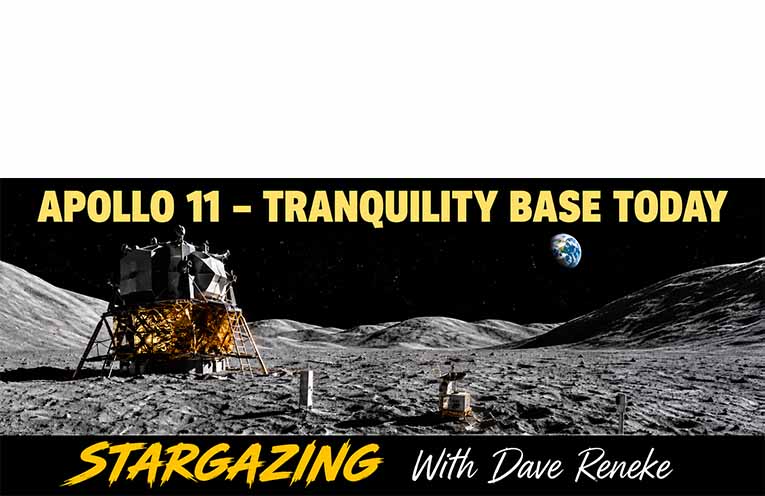
IMAGINE standing on the Moon in July 1969. There is no wind, no sound, no atmosphere and no familiar landscape – just an endless, eerie wilderness of grey dust and ancient rocks.
Neil Armstrong looks across the Sea of Tranquillity, takes those famous first steps and leaves footprints that, incredibly, are still there today.
More than half a century later, Tranquillity Base remains almost exactly where the Apollo 11 astronauts left it.
There is no memorial, no flagpole, no protective fence and certainly no visitor centre.
Instead, the first human landing site on another world sits alone in the stark lunar landscape, about 384,000 kilometres from Earth.
And remarkably, we can still see it.
NASA’s Lunar Reconnaissance Orbiter, circling the Moon since 2009, has photographed the site from above.
Its cameras have picked out the remains of the lunar module Eagle, including the descent stage that Armstrong and Buzz Aldrin left behind when they blasted off from the surface.
Around it, scientists can detect the paths made by the astronauts as they moved between the spacecraft and their scientific equipment.
It gets even more astonishing. Their footprints are still visible. On Earth, a footprint is temporary. Wind blows dust into it, rain fills it, animals cross it, and eventually nature erases the evidence.
The Moon has none of that. With virtually no atmosphere, no wind and no rain, there is nothing to wash or blow Armstrong and Aldrin’s tracks away.
Their boot prints could remain for millions of years, although tiny meteorites will gradually disturb them over enormous periods of time.
Think about that for a moment. The footprints of the first humans to walk on another world may outlast almost every human structure ever built on Earth.
The scene itself is strangely modest. There is no gigantic crater announcing the historic event and no spectacular monument visible from space. Instead, Eagle’s descent stage looks like a small piece of forgotten machinery sitting in an otherwise ordinary patch of lunar terrain.
Nearby, however, are the traces of one of humanity’s greatest adventures: astronaut tracks, equipment and the disturbed lunar soil where humans worked, jumped and shuffled across the surface.
The famous American flag is another fascinating story.
Armstrong and Aldrin planted it near Eagle, but when the lunar module’s ascent engine fired, the blast probably knocked it over.
It has spent more than five decades being bombarded by intense ultraviolet radiation and exposed to enormous temperature swings. It certainly isn’t waving. There is no breeze to make it wave anyway.
And then there is the plaque attached to Eagle. It carries the names of Armstrong, Aldrin and Michael Collins and records the extraordinary achievement with the words:
“Here Men From Planet Earth First Set Foot Upon The Moon.”
Perhaps the most haunting thing about Tranquillity Base is how ordinary it can look.
Under a high lunar Sun, shadows become short and details can almost disappear. When the Sun is low, however, enormous shadows stretch across the landscape, revealing the spacecraft, equipment and subtle tracks in the dusty surface.
For all its historical importance, Tranquillity Base is simply sitting there, exposed to the brutal environment of space, waiting patiently as the Moon continues its slow journey around Earth.
One day, humans may return. When they do, they won’t merely be visiting an old landing site. They will be walking into a kind of archaeological time capsule.
And perhaps that is the most astonishing thing of all. Armstrong’s footprints are still waiting there.
Silent. Undisturbed. And staring back at us from the surface of another world.
By Dave RENEKE