WELL, with Christmas so close we begin to anticipate the clear, balmy night skies once again, remembering what it was like last year at this time.
You may be surprised to know you are now looking at exactly the same night sky you did a year ago because every year the entire set of constellations revolves once overhead.
The stars are fixed, planets of course move. We get the name ‘planets’ from the ancient Greeks – they called them wanderers.
Our North Coast skies are at their best at this time of the year with a wealth of astronomical goodies to choose from.
If we could use the biggest telescope in the world, where would you go?
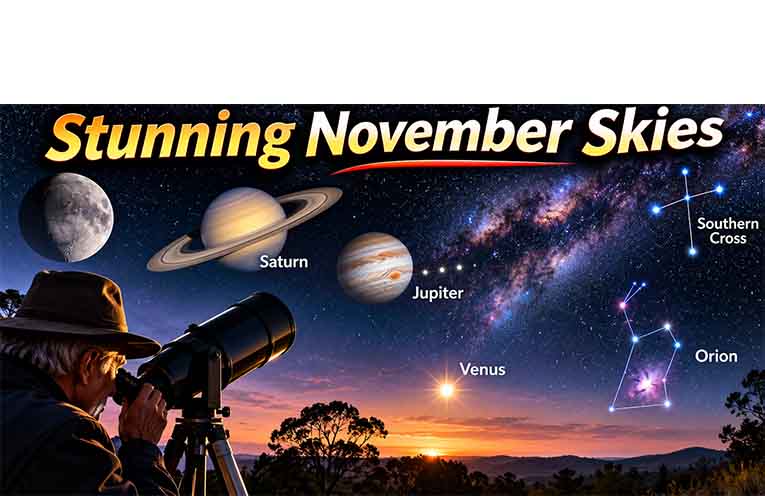
My choice would be Saturn, with the rings opening up. It’s absolutely stunning, even in tiny telescopes.
In the early hours look for Jupiter and his four tiny moons, they look like little stars in a line on either side of the planet.
When Galileo turned the first telescope on Jupiter in 1610 and saw these same moons spinning around it he knew the church was wrong in believing our earth was the centre of the solar system, with the Sun and other planets spinning around it.
It didn’t do him any good, though. He was found guilty of heresy for his dialogue, sent to his home near Florence and put under house arrest for the remainder of his life.
Ironically, the Catholic Church officially pardoned Galileo 400 years later!
Jupiter is about 40 light minutes away, meaning when you look at the planet, the light has taken all that time to reach your eye.
Jupiter can be found towards the north east, rising early in the early morning. It’s the clearest planetary object in any telescope. Catch it just before sunrise.
Got a telescope? Great, go get it.
The Moon will be around all night and into the morning, best seen while you’re waiting for the planets to rise in the pre-dawn skies. Only 60 per cent of the moon’s surface is visible from earth, we can’t see the other side from here. The moon fascinates us – how many songs do you think have been written about our closest neighbour?
Mercury is out of sight this month but Venus continues to shine brightly as the ‘morning star’ in the east just before sunrise and yes, it’s still drawing the odd UFO report or two.
People seem very disappointed when I tell them it’s a planet that’s been there for over 4 billion years!
The Southern Cross is now on its side in the southern sky and the two pointers, Alpha and Beta Centauri, sweep just above the southern horizon. Orion, the Hunter, is back in our skies after midnight and its beautifully coloured nebula will become an evening telescope favourite again in the New Year.
Speaking of colours, when you look at the amazing pictures captured by the Hubble Space telescope, do you ever wonder, is that what you’d really see with your own eyes? Does Hubble show us what the universe really looks like or do they Photoshop pictures from outer space? You’re in for a surprise!
Hubble doesn’t use colour film, in fact, it doesn’t use film at all. Rather, its cameras record light from the universe with special electronic black and white detectors.
Yep, sorry but the original Hubble pictures aren’t in colour! That’s added later in the lab.
Want a free, quality telescope? We’re running our sixth Astronomy Tour to Norfolk Island next April and you’re invited to come along.
Anyone booking a group of four or more gets the telescope absolutely free, with full lessons included! Text me on 0400 636 363 for details.
By David RENEKE