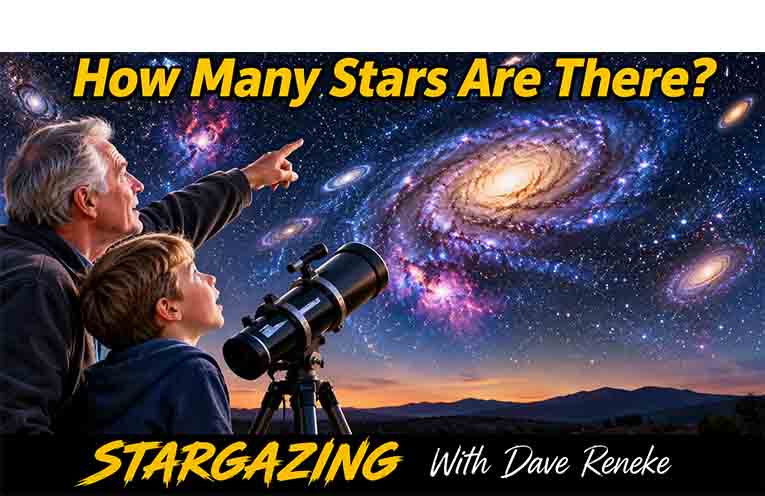
HAVE you ever stood beneath a dark, star-filled sky and wondered just how many stars are shining out there? Not just the ones above your head, but every single star scattered across the vastness of space?
It is a question that has fascinated astronomers, philosophers, musicians and dreamers for thousands of years. And the answer, quite frankly, is mind-boggling!
On a clear night, well away from city lights, you might see a few thousand stars with your naked eyes. Point even a modest amateur telescope skywards and millions more begin to reveal themselves. Suddenly, that familiar night sky becomes an astonishing ocean of light.
But here’s the thing. Those stars aren’t scattered randomly throughout space. They belong to enormous collections called galaxies. Our own Sun is just one member of a gigantic stellar family called the Milky Way, which contains an estimated 100 to 400 billion stars. And our galaxy is only one among an almost unimaginable number of galaxies in the observable Universe.
So how many stars are there altogether?
Nobody knows exactly. Astronomers estimate that the observable Universe contains something in the region of 10 sextillion to 1 septillion stars. That’s a one followed by 22 to 24 zeros! Imagine trying to count them. You’d need more than a lifetime. You’d need several lifetimes, and then some!
People often say there are more stars in the Universe than grains of sand on all the beaches on Earth. It’s a wonderful comparison, although the actual numbers depend on how you count both stars and grains of sand. Either way, the scale is almost impossible to comprehend.
And there’s another fascinating discovery. For generations, astronomers believed that most stars had companion stars, forming double or multiple-star systems. But modern surveys have shown that many stars, particularly smaller ones, live alone. Not every star has a partner!
That matters because planets can form around single stars, just as they did around our Sun. Double-star systems can have planets too, but their gravitational interactions sometimes make planetary orbits more complicated. The possibility of countless other single-star systems raises an exciting question: just how many Earth-like worlds might be out there?
So where do all these stars come from?
The story begins inside enormous clouds of gas and dust drifting through space. Gravity slowly pulls the material together, squeezing it into increasingly dense, hot regions. Eventually, temperatures and pressures become high enough for nuclear fusion to ignite. A new star is born, and another little lighthouse begins shining in the cosmic darkness.
The Universe itself is thought to be about 13.8 billion years old. Astronomers can now observe light from some of the earliest galaxies, dating back to within a few hundred million years of the Big Bang. T
hat light has travelled across space for more than 13 billion years before reaching our telescopes today. We’re looking back through time!
And what about the shape of the Universe? Measurements suggest that space is remarkably flat on the largest scales. That doesn’t mean it’s a flat sheet, nor does it prove the Universe is infinite. It may extend endlessly, but scientists still haven’t established whether it has an ultimate boundary.
Think about that next time you look up. Every tiny point of light represents a distant star, often with its own extraordinary history. Some may have planets. Some may have moons. And somewhere, perhaps, other eyes are looking back at their own night sky, wondering exactly the same thing.
The Universe is not simply big. It is almost beyond imagination. And the most astonishing part? We’re only just beginning to discover what’s out there.