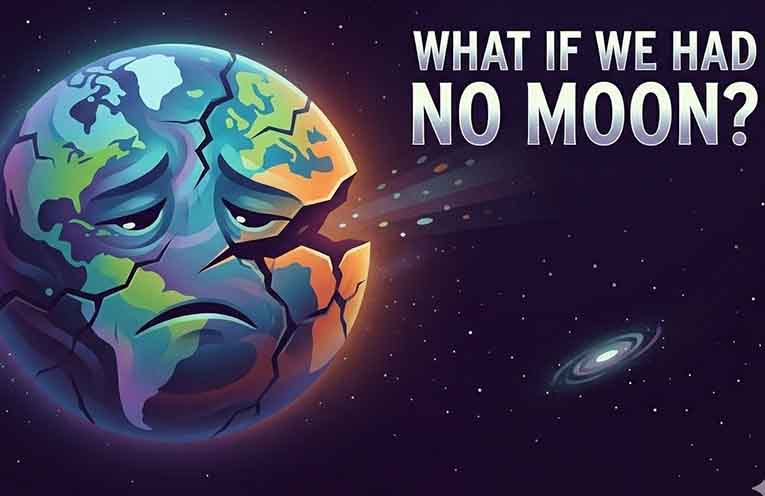
IMAGINE a world where the Moon never showed up for its nightly shift.
No silver spotlight draped across oceans, no quiet companion hanging above late-night thinkers.
Just a blazing Sun clocking out each evening and leaving us with… a blackout.
Romantic? Not exactly.
Mysterious? Maybe – but mostly inconvenient.
Let’s start at the beach.
Without the Moon’s gravitational pull, tides would shrink into polite little ripples, like the ocean forgot how to be dramatic.
Gone are the surging waves that crash with flair; instead, we’d get something closer to a lazy shoreline shrug.
Sure, the Sun would still tug at the oceans, but it’s like comparing a symphony to someone tapping a spoon on a mug. Predictable, mild, and a bit dull.
“Oh look, it’s high tide again… how thrilling.”
And then there’s the night sky – or what’s left of it.
Without the Moon’s glow, stargazing might actually improve (hello, galaxies!), but stepping outside would feel like walking into a pitch-black room and hoping for the best.
Midnight strolls would turn into obstacle courses.
Romance would take a hit too. It’s hard to whisper sweet nothings when you’re busy tripping over your own feet.
Culturally, we’d be in trouble.
No “moonlight” anything.
No iconic songs crooning about lunar longing.
Replace “Fly Me to the Moon” with “Fly Me Toward That General Direction of Space” and suddenly it’s not quite the same vibe.
Poets would scramble for metaphors.
“Your eyes shine like… distant traffic lights?” Not great.
The real chaos, though, comes from Earth itself.
The Moon doesn’t just sit there looking pretty – it stabilizes our planet’s tilt.
Without it, Earth could wobble like a spinning top running out of patience.
That means seasons going rogue.
Imagine one year of scorching heat followed by decades of deep freeze. Weather forecasts would become wild guesses.
“Tomorrow: possibly summer, possibly ice age. Dress accordingly.”
Wildlife wouldn’t escape unscathed either.
Many animals rely on moonlight for navigation, hunting, and reproduction.
Sea turtles, for example, use the glow of the horizon – often influenced by the Moon – to find their way.
Without it, their journeys could become confused and chaotic.
Predators and prey alike would have to rewrite their survival playbooks in a darker, less predictable world.
And then there’s the folklore we’d lose.
No werewolves dramatically howling at the full Moon – just regular wolves, howling at… vibes, I guess.
No “man in the Moon” to spark imagination. Bedtime stories would feel emptier, stripped of that glowing, watchful presence.
The sky would be vast, yes – but also strangely blank, like a story missing its main character.
Even human behaviour might shift.
While the science is debated, there’s long been a belief that full moons stir something in us – restlessness, energy, maybe a dash of mischief.
See that rhythmic brightening of the night, our connection to natural cycles could feel a little less magical, a little more mechanical.
In the end, a moonless world wouldn’t just be darker – it would be quieter, flatter, less poetic.
The Moon doesn’t just light our nights; it shapes our planet, our stories, and our sense of wonder.
Take it away, and we’re left with a sky that works… but doesn’t quite sing.
Dave’s website: www.davidreneke.com.
By David RENEKE