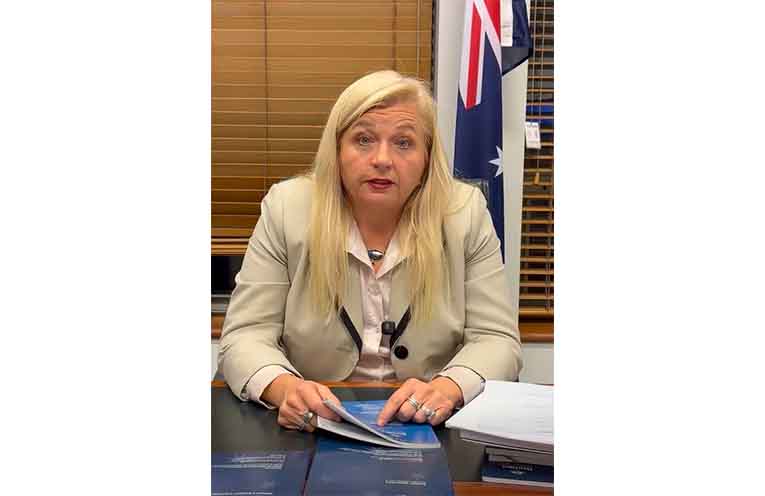
NATIONALS Member for Lyne Alison Penfold has called the Labor Government’s Federal Budget a “bloodbath for regional Australia”.
In her response to Labor’s Federal Budget, delivered by Treasurer Jim Chalmers on 12 May, Ms Penfold said regional and rural communities like those in Lyne had been left behind.

“Budgets can make or break the ability of our region to thrive, and this Budget lets us down big time,” Ms Penfold said.
Her key concerns are related to the funding of roads, health, water and telecommunications.
“In terms of local services and infrastructure, there is no funding for the roads and grade-separated interchanges on the Pacific Highway, which our communities need.
“They have stripped $21.4 million from regional telecommunications funding making the challenge of addressing mobile and internet blackspots even harder.
“$103 million has been cut from the National Water Grid – the pool of funds that had the potential of providing funds to MidCoast Council for the Kiwarrak Off-River Water Storage Project to secure the Manning’s long term water supply.
“In a funding commitment of $1.8 billion for Urgent Care Clinics, there is no funding for one in Taree despite the clear case that has been presented to them over the past 12 months.
“There is a pittance for aged care which won’t even scratch the sides of the Support at Home Waitlist, or address provider and workforce shortages in the regions.”
However, Ms Penfold acknowledged several measures in line with her pre-budget submission.
These include $2 billion for housing infrastructure such as power, water and sewerage, an additional round of the Stronger Communities Program, further funding for the Growing Regions Program and an extension of the Local Sporting Champions programs.
“A few small positives do not excuse a Budget that has fundamentally forgotten communities from the Hunter to the Hastings,” she said.
Key measures
In a joint statement, the Treasurer, Prime Minister Anthony Albanese and senior ministers, described the Budget as being about “resilience and reform.”
“It’s all about getting Australians through the global oil shock and building an economy that works for more people.
“We’re delivering more cost‑of‑living help and building a more productive economy, a better tax system, a fairer housing market and a stronger and more sustainable budget,” the statement read.
The Budget focuses on cost-of-living relief, housing tax reform, and energy security.
A $31.5 billion deficit is forecast with $45 billion in improved revenue.
Key measures include:
– Income Tax Cuts: From July 1, 2026, the 16% tax rate for incomes $18,201–$45,000 drops to 15%.
– Worker Offset: A new $250 permanent Working Australians Tax Offset and a $1,000 instant tax deduction for work-related expenses.
– Medicare: Increased Medicare levy low-income thresholds.
– Negative Gearing: Limited to new builds, with existing investments grandfathered.
– Capital Gains Tax (CGT): The 50% CGT discount is scrapped and replaced by an indexation system to target real gains.
– Securing Australia’s near‑term fuel and fertiliser security through Export Finance Australia’s $7.5 billion Fuel and Fertiliser Security Facility.
– Strengthening longer term fuel security with a $3.2 billion Australian Fuel Security Reserve.
– Boosting energy sovereignty by making more clean fuels in Australia, promoting electrification, and implementing a 20 percent gas reservation.
– Approvals: $500 million+ to expedite environmental and project approvals using AI.
Confidence in councils
Australia’s peak local government body, the Australian Local Government Association, says the Federal Budget is a vote of confidence in the country’s 538 councils to deliver on national housing infrastructure priorities.
But it argues that more needs to be done to address the growing financial pressures threatening local government services across the country.
ALGA President Mayor Matt Burnett said councils were on the frontline of delivering national productivity, housing growth, climate resilience and essential local services, but needed to be backed to deliver.
“We welcome the Federal Government’s trust in local government to support new housing and growing communities, through its announcement of $2 billion over four years to help deliver enabling infrastructure,” Mayor Burnett said.
“However, councils have not been given the same support to meet local community needs through secure untied funding and, in fact, support through Financial Assistance Grants has gone backwards as a share of Commonwealth taxation revenue.”
Mayor Burnett said the ALGA also welcomed the ongoing attention on local government sustainability through the Inquiry into Local Government Funding and Fiscal Sustainability.
By Sue STEPHENSON