HAVE you ever wondered who the first astronomers were?
What an interesting question.
Astronomy is the oldest science, but it’s also the newest.
Everything we know about the night sky has been passed down through history, and we find the oldest continuous culture on Earth, the Australian Aboriginal people, were very likely the world’s first astronomers.
Quite an accolade!
Aboriginal Australians have been gazing at the night skies for thousands of years.
It seems they even pre-dated monuments like Stonehenge, estimated at 3100 BC.
Historians have been studying Dreaming stories and deciphering cave drawings to build a picture of the heavens as seen by these ancient cultures.
Tribes used the sky for navigation, timekeeping and to mark out the seasons.
They ordered their lives by the stars.
Most groups have stories that explain tides, eclipses and the rising and setting times of the Sun and Moon.
In one story, Walu the Sun is a woman who lights her fire every morning and scatters red ochre across the clouds, creating dawn.
She then carries her torch across the sky, creating daylight.
At the end of the day, she descends, puts out her fire, and travels underground through the night back to her morning camp.
Cool, huh?
My favourite Dreaming story is about the Southern Cross, or Crux. One Northern Territory Aboriginal group believed it was once a giant stingray, with the two pointer stars as sharks chasing it out of the sky.
You can’t beat these stories for sheer drama and imagination.
To groups near the border of Victoria, it represents the four unmarried daughters of a tribal elder named Mulululu.
Star patterns were vital.
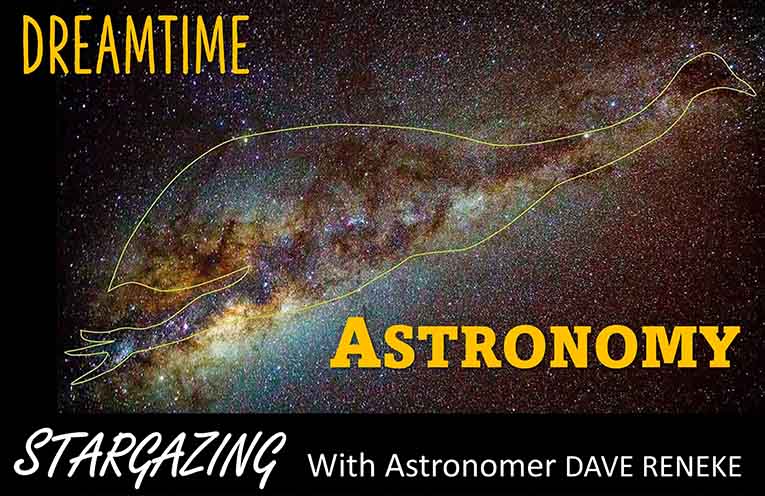
For example, the “Emu in the Sky,” formed by dark dust lanes in the Milky Way, appears to run or sit at different times of the year.
Depending on its position, some groups knew when to hunt emus or collect their eggs. Neat, huh?
May these stories live forever!
The lure of the night sky has always been powerful. For Aboriginal Australians, it was a living map of law, survival and spirit.
Other civilisations, like those of Ancient Egypt or Mesopotamia, also studied the stars, but often to predict floods, track gods or build calendars.
While many cultures charted constellations, Aboriginal astronomy stands apart in seeing the sky not just as points of light, but as shapes in darkness and stories embedded in the land.
Today, despite satellites and telescopes, the night sky still draws us in.
Whether ancient or modern, we are united by the same sense of wonder – looking up and asking where we came from. So, what’s going to happen to all these stars?
Will our Universe keep expanding forever, or will it eventually slow down and collapse into a “Big Crunch,” the opposite of the Big Bang?
Perhaps the Universe recycles itself over and over.
If so, the answer to “where did the Universe come from?” may simply be – another universe.
Hey, got a question about the night sky?
See Dave’s website: www.davidreneke.com.
By Dave RENEKE