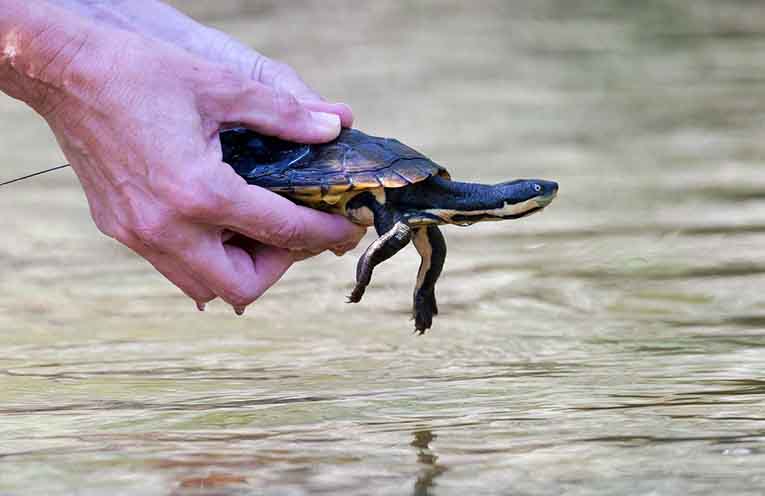
NEW research indicates Manning River turtles are being recorded at pre-flood numbers, twelve months after one of the region’s worst floods on record.
Waterways in the Hunter and Mid North Coast were battered in the floods of May 2025, with serious concerns held about the long-term effects on fish and animals living in the rivers, particularly on the endangered Manning River turtle.

Found only on the Mid North Coast, the turtle has been monitored in seven rivers over the past four years by the NSW Department of Climate Change, Energy, the Environment and Water (DCCEEW).
A study released last week by DCCEEW found that while the turtle remains endangered, its population has persisted in the Barnard River, upper Barrington River and upper Gloucester River post-flooding.
However, it stated that turtles may have been displaced further down the river system.
“While (flood) recovery is ongoing, we’re starting to see some encouraging signs – particularly when it comes to the health of the river itself,” said Mitchell Isaacs, Executive Director of Water Planning and Knowledge at DCCEEW.
“We’re now seeing the endangered Manning River turtle show up back in sites where they were prior to the floods, in good numbers.”
Underwater video surveys used to observe the turtles as part of the Manning River Results Survey also captured valuable information on fish communities.
Following the May 2025 flood, several native fish species that rely on estuaries and lowland rivers for spawning have also shown a boost in young fish populations, with large numbers of juvenile Australian bass, freshwater herring and freshwater mullet being detected.
“Fish populations are also recovering well, with some species even booming,” Mr Isaacs said.
“Taken together, the turtle and fish results show that despite the flood damage, the Manning River system is resilient.
“We want to continue monitoring this important catchment to ensure we can track how things fare during future droughts and floods.
“When we support healthy river habitats through environmental flows, native species can recover from disaster and even start to thrive.”
In February Aussie Ark conducted a wild release of 21 endangered Manning River Turtles into the Barrington River, with eight turtles fitted with VHF transmitters for ongoing monitoring.
The release was delivered in collaboration with Western Sydney University’s Professor Ricky Spencer and DCCEEW, with all turtles bred in the Conservation Ark facility in Somersby NSW.
By John WATTS