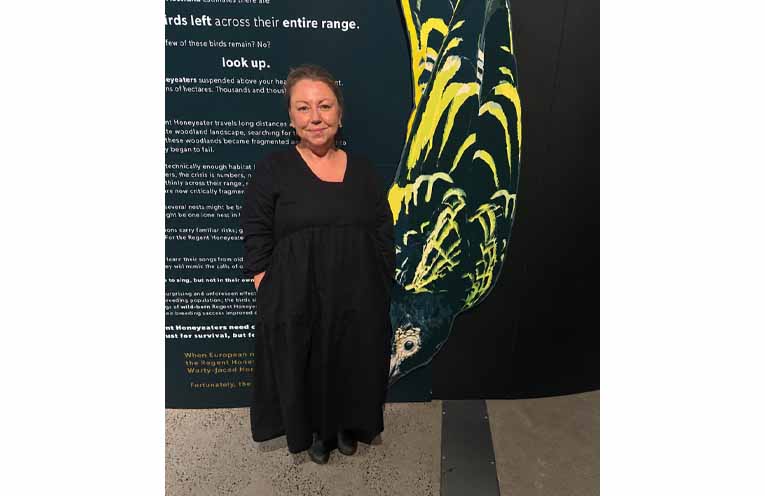
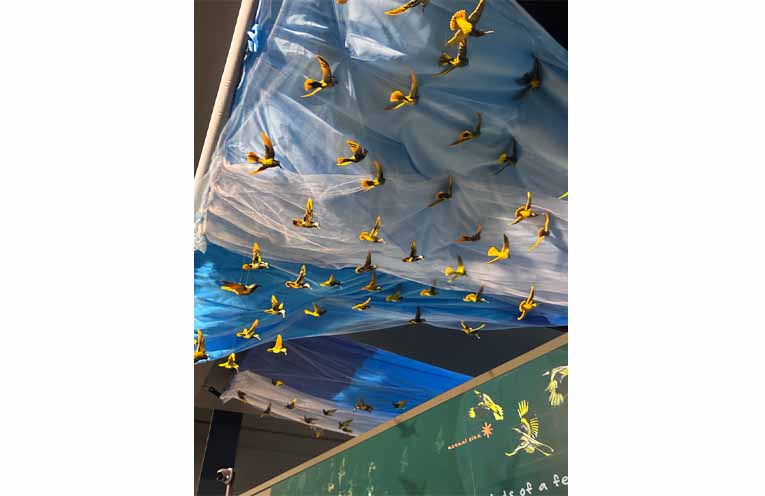
HUNDREDS of small yellow and black birds hang overhead in Murrook Culture Centre in Williamtown.
They are there to show visitors just how few Regent Honeyeaters remain in the wild.

The installation is the work of Murrook’s curator director Nicole Chaffey.
It features 350 individually painted resin birds, representing an optimistic upper limit of the remaining population, estimated at around 300.
In the wild, their numbers are being boosted by the release of zoo-bred birds, according to BirdLife Australia Regent Honeyeater Recovery Advisor Mick Roderick.
For Ms Chaffey, an accurate number was central to her work.
“I wanted to show the number of birds left, not some abstract, random number,” Ms Chaffey said.
She spent weeks adding their finer markings with paint pens, often working at home on the lounge while watching television.
Mr Roderick helped Ms Chaffey develop the information that supports her installation and was enthusiastic about the result.
“It’s the best public information display on Regent Honeyeaters anywhere,” Mr Roderick said.
“The way she’s captured the entire estimated population on the ceiling is very compelling.”
The birds’ song also caught Chaffey’s attention: With fewer adult males around, young Regent Honeyeaters may struggle to learn their own species’ song.
She drew a connection between the role of Elders in passing on language, culture and knowledge between generations.
Roderick said evidence suggests female Regent Honeyeaters choose males with the full song over males that mimic other birds.
Habitat loss has added to the species’ plight.
Much of the woodland in areas with low-lying, fertile soils has been cleared for farming. Remaining patches are fragmented and often dominated by Noisy Miners, which drive out Regent Honeyeaters.
The installation also references mistletoe, which Roderick described as “a very misunderstood habitat resource”.
There have been encouraging signs following the earlier releases of zoo-bred birds. Some have been seen to have survived, paired with wild birds and bred.
“These are great markers of success,” Roderick added.
For visitors wanting to support the survival of the species after seeing the display, his advice was to report possible sightings to BirdLife Australia.
By Althea GUINSBERG