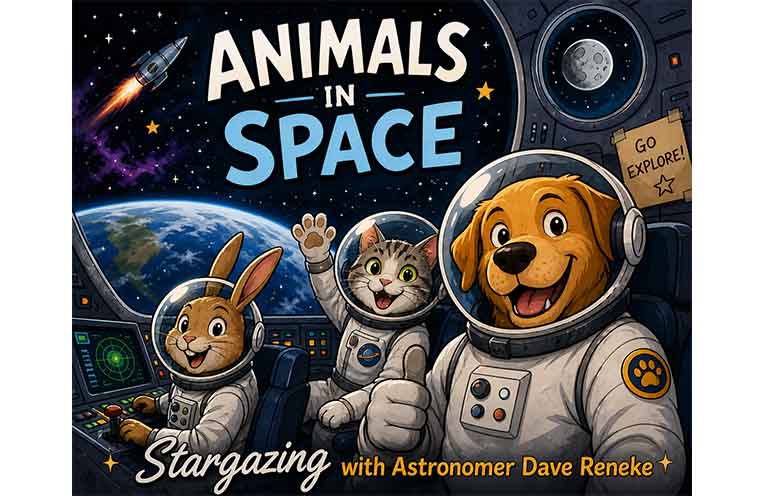
LONG before humans walked on the Moon and planted their footprints in lunar dust, others made the journey first – silently, bravely, and often without return.
Animals were the earliest pioneers of spaceflight, sent ahead to answer a simple but vital question: could life survive beyond Earth?
The story begins in 1947, not with a dog or a monkey, but with something far smaller – the humble fruit fly. American scientists, using a captured German V-2 rocket after World War II, launched these insects to an altitude of 109 kilometres, widely considered the edge of space.
Their mission was straightforward: test the effects of cosmic radiation on living tissue.
When the capsule parachuted back to Earth and was recovered in New Mexico, the flies were found alive and unharmed.
It was a crucial success.
It proved that living organisms could survive a trip into space – and return.
From there, the stakes grew higher.
In 1948 and 1949, the United States began sending primates aloft.
The first, a rhesus macaque named Albert I, never made it to space; he died from suffocation before the rocket left the ground.
A year later, Albert II reached 134 kilometres, officially entering space.
But triumph turned to tragedy when his parachute failed during re-entry, killing him on impact.
Over time, 32 monkeys and apes were sent into space, including rhesus macaques, squirrel monkeys, and chimpanzees.
These missions helped scientists understand the effects of acceleration, weightlessness, and stress on living bodies.
One of the most famous survivors was Ham, a chimpanzee launched by NASA on 31 January 1961.
Unlike many before him, Ham returned safely to Earth.
His flight showed that tasks could be performed in space – a key step toward human missions.
He lived out his life in relative comfort, dying in 1983.
While the Americans focused on primates, the Soviet Union turned to dogs.
In 1957, the world met Laika, a stray mongrel picked up from the streets of Moscow.
Chosen for her calm temperament, she became the first animal to orbit Earth aboard Sputnik 2.
It was a one-way journey.
Official reports claimed she survived for days.
The truth, revealed years later, was harsher. Laika died just five hours into the flight due to overheating.
Despite her fate, her mission proved that a living creature could survive launch and orbit – a major milestone.
By the time humans reached the Moon in 1969, stepping onto its surface before a global audience, the role of animals in space had already reshaped science and engineering.
Their sacrifices had helped answer the unknowns that once made space seem unreachable.
After the Moon landing, the urgency to send animals into space declined, but they were not entirely retired. In 1973, a more unusual experiment took place aboard the Skylab space station.
Two garden spiders, Anita and Arabella, were sent into orbit to study how microgravity would affect their ability to spin webs – an idea from a Massachusetts high school student, Judith Miles.
Remarkably, both spiders adapted.
They spun webs in space, though finer and slightly different from those on Earth.
The experiment provided insights into how organisms adjust their movements in weightlessness.
From fruit flies to spiders, monkeys to dogs, these early travellers played a critical role in humanity’s journey into space.
Their missions were often risky, sometimes tragic, but always meaningful.
Before astronauts could look back at Earth from orbit or walk on another world, animals had already taken that first uncertain step into the unknown – and, in doing so, helped make the impossible possible.
See Dave’s website: www.davidreneke.com.
By Dave RENEKE