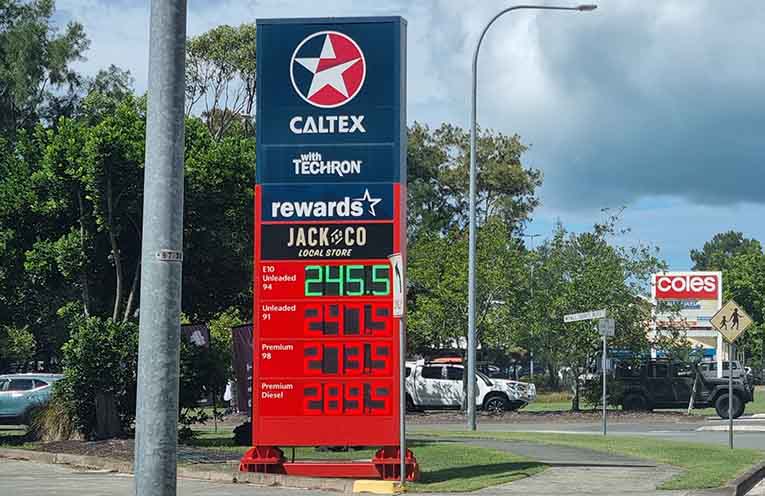
GLOBAL events, most notably the closing of the Strait of Hormuz, have seen petrol and diesel prices skyrocket in the last few weeks, with a jump of 10 cents per litre (c/l) seen in a matter of days.
As of Sunday 22 March 2026, crude oil prices are around US$122 per barrel – high by any standard, especially considering that US$100/barrel is both a historical and psychological threshold – but it means little to the suburban or regional motorist, who rightfully worries most about the price at the pump.
While petrol prices continue to rise on a daily basis, it is pertinent to consider the hidden costs built into the big board along the kerb.
Australia imports a staggering 90 percent of its liquid fuel needs, all of which are hit with an automatic federal ‘fuel excise’ – another name for a tax – as soon as it leaves the supplier’s depot.
The fuel excise is recalculated every six months and is tied to the consumer price index to keep up with inflation, although in the relatively rare event that CPI decreases, the fuel excise does not also decrease, it just stays stationary until the next rise.
The latest fuel excise recalculation was in February 2026, and the Australian Tax Office confirms that the fuel excise is now set at 52.6 cents per litre.
This means that every litre of fuel that comes into Australia is automatically 56.2c dearer, before it reaches any retail service station.
At the servo, the pump price is, of course, at the discretion of those running the business, and will invariably pass on the excise entirely, as well as a 10 percent GST imposed by the Federal Government.
The GST is 10 percent of the pump price, inclusive of the excise carry-over, meaning that motorists pay a tax on a tax.
A standard modern family SUV (Rav4, X-Trail etc) has a petrol tank up to 60L.
So, at the current price of $2.50/Litre, including an excise of 52.6c/Litre and 10 percent GST, a driver may pay up to $150 in fuel, plus $33.72 in excise, then another $18.37 in GST (calculated at 10 percent including the excise), for a grand total of $202.09.
According to the federal Parliamentary Budget Office (PBO), “[The fuel tax] is one of the oldest taxes in Australia, applying since Federation in 1901.”
“Since 1992, fuel tax has been a general revenue-raising tax with only a minor link with the Australian Government’s overall level of road funding,” explains the PBO.
The Australian Automobile Association (AAA), the self-described “peak organisation for motoring clubs” in the country, claims that “Australian motorists paid an estimated $15.71 billion in net fuel excise in 2023-24, but, over the decade to 2022-23, only 57 percent of fuel excise was reinvested in land transport projects.”
The AAA calls for every cent of fuel excise to be reinvested into land transport projects.
It is entirely possible for the Australian Government to lower the excise, with the most recent precedent occurring in the Budget for 2022-23, when then-Treasurer Josh Frydenberg (Morrison Liberal Government) announced a temporary six-month halving of the excise.
“Events abroad are pushing up the cost of living at home: higher fuel, food and shipping costs are increasing inflation and stretching household budgets,” Mr Frydenberg said in 2022.
Practically speaking that temporary excise halving saved Australians 22c/L every time they filled up, equating to “around $700 saved over the six months by a family with two cars filling up once a week.”
“Events abroad” referred to the Russian war in Ukraine, which was new at the time, as well as the jump in fuel demands as the world emerged from COVID-19 lockdowns.
It is also worth noting that 2022 was a federal election year, and 2023 was a NSW state election year.
By Thomas O’KEEFE