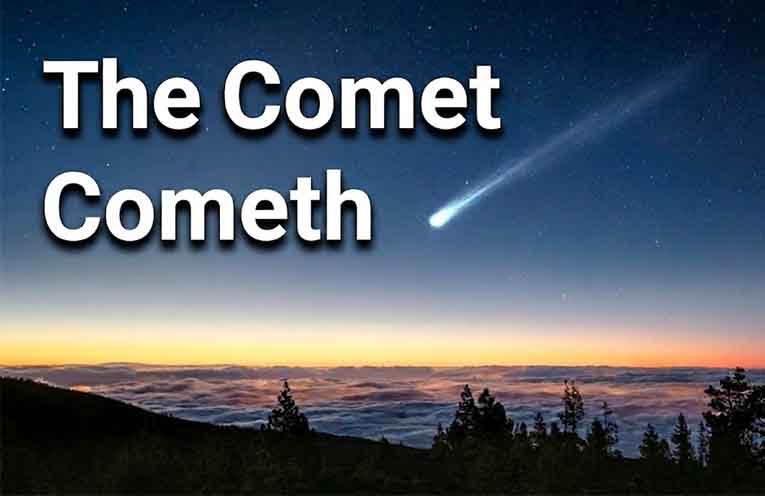
A VISITOR from the deep past is about to grace Australian skies.
For those willing to rise before dawn, it offers something close to time travel.
The long-period comet C/2025 R3 (PanSTARRS) – last seen when humans were shaping stone tools and learning to master fire – has returned after an absence of roughly 170,000 years.

As the comet sweeps inward toward the Sun, reaching perihelion on 19 April before passing relatively close to Earth on 26 April, observers across Australia are in a prime position to witness it.
Away from city glare, coastal towns offer ideal viewing conditions: dark horizons over the Pacific, crisp autumn air, and early morning skies unspoiled by artificial light.
Look toward the constellation Pegasus constellation, specifically the easily recognisable “Great Square”, just before sunrise.
With luck and clear weather, the comet may glow faintly to the naked eye, its tail stretching like a ghostly brushstroke across the sky.
Comets have long stirred human imagination.
In antiquity, they were often seen as omens – harbingers of change, disaster, or divine intervention.
The appearance of Halley’s Comet, for example, was recorded in 1066 and later embroidered into the Bayeux Tapestry as a portent of conquest.
Today, we understand comets not as supernatural signs but as icy relics – frozen leftovers from the formation of the solar system 4.6 billion years ago.
Each one is a time capsule, composed of dust, rock, and volatile ices that vaporise as they near the Sun, forming the luminous coma and tail.
What makes C/2025 R3 extraordinary is its orbit.
Unlike short-period comets that return every few decades, this one hails from the distant Oort Cloud, a vast spherical halo of icy bodies surrounding the solar system.
Its elongated path means it spends most of its existence in deep space, only briefly visiting the inner planets before retreating again into darkness.
No written record, no ancient chronicle, no civilisation has ever documented its passage – until now.
For photographers, capturing this rare visitor is both a challenge and a thrill. A sturdy tripod is essential, along with a camera capable of long exposures.
Use a wide-angle lens to frame the comet against the landscape – perhaps the silhouette of Norfolk pines along the NSW coast or the curve of a quiet beach.
Start with exposures of 5–15 seconds, adjusting ISO and aperture depending on brightness.
If you have binoculars or a small telescope, you’ll see more detail: the nucleus glowing at the centre, the tail fanning outward like cosmic smoke.
There is something deeply humbling about standing under the same sky that Stone Age humans once gazed upon, watching the return of an object they may also have seen – perhaps with wonder, perhaps with fear.
Long after our cities fade and our histories blur, C/2025 R3 will continue its silent journey, looping back again in another 170,000 years.
For now, though, it is here.
Step outside before dawn. Look up. And take your place, however briefly, in the long story of the sky.
See Dave’s website: www.davidreneke.com.
By David RENEKE