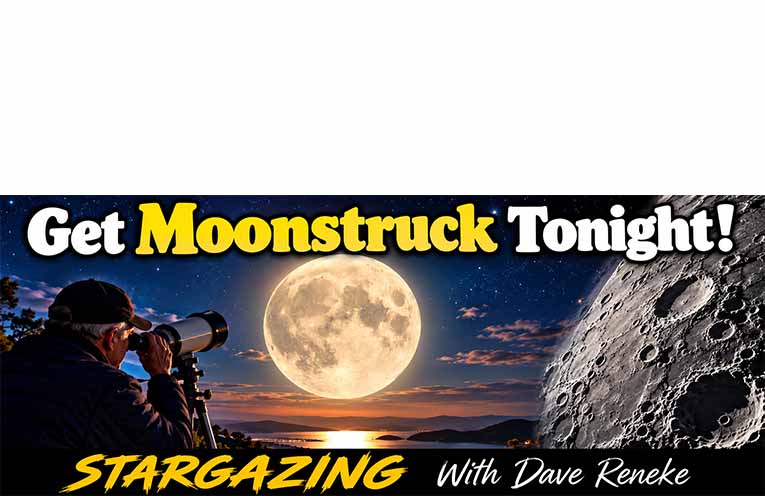
WITH a nice full Moon it’s going to be a great week for lunar studies and an even better time to haul out that telescope you got last Christmas and left in the garage.
The Moon makes for an easy target. OK, keep an eye on the skies this weekend as we head outside for a better look.
Tonight let your imagination sweep you away as we go mountain climbing – on the Moon!
The Moon rises at dusk for most of Australia this week, which means it’s going to be bright and visible all night long.
It’s a great time for newbie astronomers to check out the valleys, hills and craters as well. Some of those smaller craters seen through your scope are dozens of kilometres wide and hundreds of metres deep!
The craters were formed by asteroids and comets that collided with the moon. It’s a rugged terrain. Roughly 300,000 craters wider than one kilometre are thought to be on the Moon’s near side alone. That’s a lot of holes.
And you thought our highways were bad.
Find the large, grey, flat area that makes up the ‘left eye’ part of the ‘Man in the Moon’ face.
The Sea of Fertility, as it is called, stretches 1,500 kilometres in diameter, equal in size to the Great Sandy Desert here in Australia, and almost as vacant in interior features.
The Moon has only one sixth of our gravity, so you’d have a ball if you’re the athletic type. You’d be able to run six times faster, jump six times higher, and – listen to this – you could probably lift one side of your car quite easily with two hands on the lunar surface!
You know, from the Moon, our Earth appears nearly four times larger than a full moon appears to us, and shines around 45 times brighter than a full moon.
That’s why the Moonwalkers always had heavy Polaroid visors and probably a good reason they couldn’t see any stars overhead. Bang goes another conspiracy theory!
Not many people know our Earth seen from the moon also goes through phases, however they’re opposite to the lunar phases that we see from the Earth.
From any spot on the Moon, when you can see it, the Earth would always be in the same place in the sky. Weird huh?
Well, it’s October so welcome to the Hunter’s Moon this Monday.
Rooted in traditional Northern Hemisphere lore, it marked the time when fields were cleared and game animals were visible and fattened ahead of their winter.
Tradition, folklore and the Moon seem to go hand in hand, especially where our calendars are concerned, don’t they?
After the fields have been reaped, the leaves begin to fall, then the animals are fat, ready for eating. Yum!
Want some quirky Moon facts?
Thought so.
The Moon’s strong gravity stabilizes our spinning axis. Without the Moon, Earth would wobble wildly, creating extreme shifts in climate and possibly making it difficult for life to evolve on Earth.
The lunar gravity also creates ocean tides, which might have helped primitive life to move from the sea onto land.
Travelling at highway speeds, a car would take five months to cover a distance 384,400 kilometres between the Earth and the Moon, while a jet aircraft would perform this feat within a span of three weeks.
Apollo 11 took 3.2 days to get there, while the beam of light does so just within the small time of 1.28 seconds.
See Dave’s website at www.davidreneke.com.
By Dave RENEKE