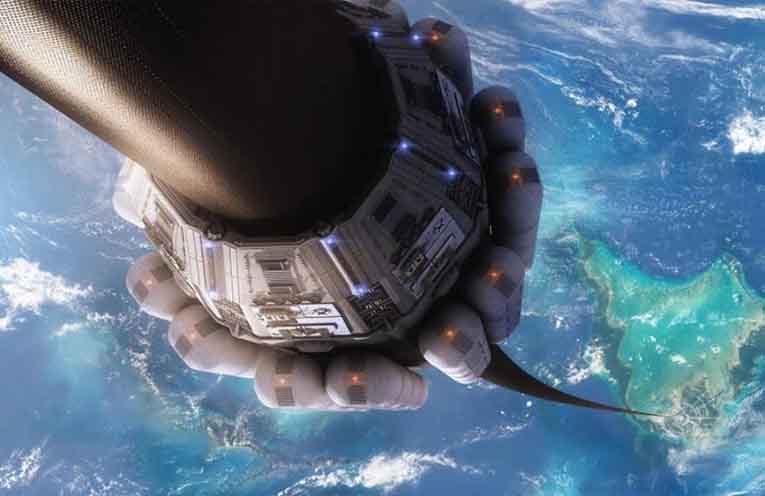
IMAGINE stepping into an elevator, pressing the “up” button, and eight days later stepping out into space.
No rocket roar. No fiery launch. No crushing G-forces. Just a ride straight up.

It sounds unbelievable, yet the idea of a space elevator is beginning to look surprisingly real.
The concept is simple but astonishing.
Picture a cable about 100,000 kilometres long stretching from Earth to an orbiting platform far out in space.
Special vehicles called “climbers” would travel up and down the cable carrying cargo, satellites and eventually people.
In effect, it would be like a vertical railway linking Earth with space.
For decades this idea belonged firmly in the world of science fiction. However, some scientists believe the technology could actually work.
With the right materials and engineering, space elevators could become reality within a couple of decades.
If that happens, the impact could be enormous.
Launching objects into orbit using rockets currently costs thousands of dollars per kilogram.
A space elevator could slash those costs dramatically, possibly to less than US$50 per kilogram.
That would make putting satellites into space far cheaper and could even open the door to routine human travel beyond Earth.
The biggest challenge is the cable itself. It must be unbelievably strong and incredibly light, strong enough to stretch tens of thousands of kilometres into space without snapping under its own weight.
For many years no material on Earth could do the job.
Then scientists discovered something remarkable: carbon nanotubes.
These are tiny cylinders made of carbon atoms arranged in sheets similar to graphite, the same substance found in pencil leads.
Despite their microscopic size, carbon nanotubes are amazingly tough.
They are flexible, extremely light and up to one hundred times stronger than steel.
With materials like these, what once sounded like a “Jack and the Beanstalk” fantasy could become a real transportation system for space travellers.
The cable itself might be only about one metre wide and thinner than a sheet of paper, yet capable of supporting loads of up to thirteen tonnes.
Even more astonishing is how the structure would stay upright.
The cable would be anchored near Earth’s equator and stretch far beyond geostationary orbit.
At the far end, a huge counterweight, possibly even a captured asteroid, would keep the cable pulled tight.
Because the Earth is spinning, the entire structure would remain stretched outward, much like the string of a yo-yo when it is swung around.
Once the system was operating, electromagnetic climbers would glide along the cable carrying passengers and cargo between Earth and a transfer station high above the planet.
Instead of explosive launches, reaching orbit might one day feel more like taking a very long elevator ride.
Building such an enormous structure might sound impossible, but engineers have a surprisingly simple strategy inspired by bridge building.
First, a satellite would deploy a very thin cable down toward Earth.
Then robotic climbers would crawl up the cable, attaching additional strands each time they travelled.
Gradually the cable would grow thicker and stronger until it could handle heavy loads.
Early experiments have already begun.
Researchers have even held serious workshops at NASA to study the idea.
What once sounded like pure fantasy is now being discussed as a genuine engineering challenge.
Science fiction writer Arthur C. Clarke was once asked when such a thing might finally be built.
His reply became famous: “About fifty years after people stop laughing.”
It seems people may finally have stopped laughing.
One day the journey to space might begin with nothing more dramatic than pressing the “up” button in an elevator. See Dave’s website: www.davidreneke.com.
By David RENEKE