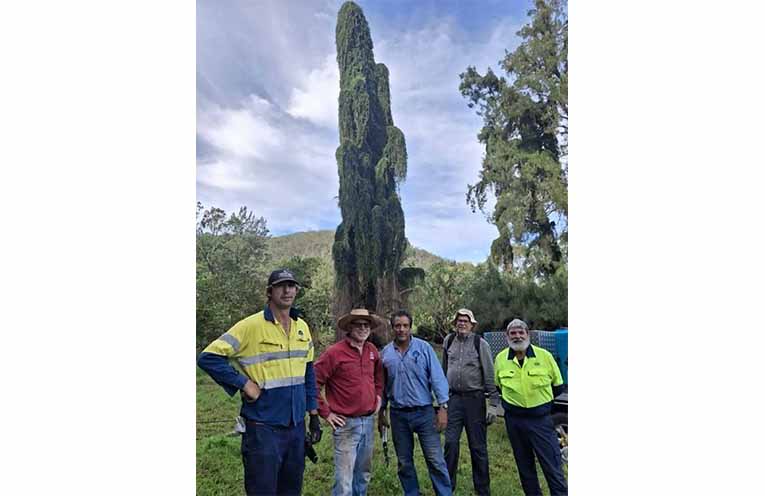
RIVER sheoaks and weeping lilly pilly that are hundreds of years old are being strangled by the rapidly growing and highly invasive Claw Creeper growing along the Williams River.
This introduced vine forms dense mats, covering and outcompeting native vegetation up to 30 metres in height.

The species name, Dolichandra unguis-cati translates to ‘long tendril of the claw’, highlighting the plant’s distinctive claw-like tendrils that aid in climbing.
A working bee to address this weed on the Williams River was put forward by Ron Patron, biosecurity weed management officer for Dungog Shire Council.
It was agreed at a Hunter Weeds technical team meeting that it was a good way to educate local landowners on the problems the weed could cause and show them how it could be controlled.
Matt Kennedy, from Local Land Services, was very helpful in coordinating the event, which occurred on a private property at Fosterton near Dungog on the Williams River on 10 June.
There were 20 active weed wranglers in total.
Matt and Ron were very pleased with the turnout.
“We had participants from local landowners, Local Land Services (Hunter), a Newcastle University student, Hunter Water, Mid-Coast Council, Newcastle Council, Port Stephens Council, Cessnock Council, AEOM contractors
and local Landcare, prepared to roll their sleeves up and tackle this beast,” Ron said.
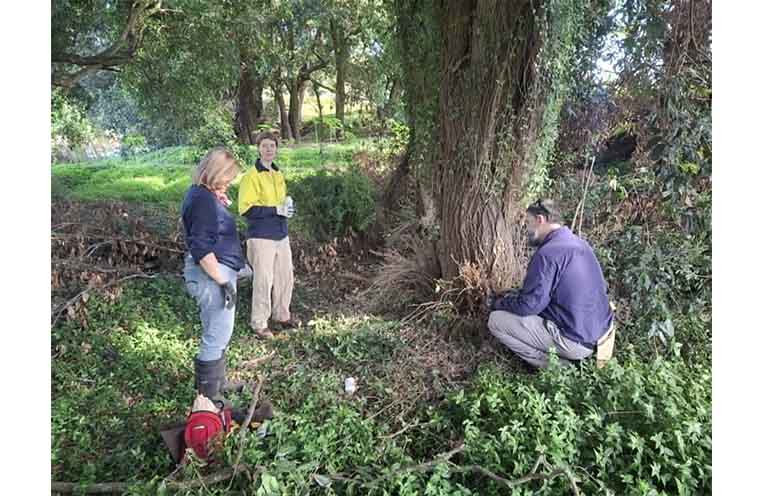
Working in pairs and small groups the teams painted herbicide on the cut stems. Chainsaws were at times required due to the size of the vines.
In the course of four hours the group managed to free nearly 50 trees.
It was a satisfying result but ongoing efforts will be required as well as regular follow-up treatment of new seedlings.
Cat’s Claw Creeper is an asset protection priority weed for the Hunter Region and a priority weed in four other LLS regions of NSW
It is listed as a Key Threatening Process in New South Wales because of its impact on endangered and vulnerable plants, as well as Lowland Subtropical Rainforest, which is an Endangered Ecological Community.
The Hunter Weed Technical Team hopes that a local landholders’ group will establish (such as Landcare, Community Builders or similar grass roots community groups), which can help each other to restore the health and beauty of the Williams River and its banks and protect our significant environmental and agricultural assets into the future.